For teams of 5 to 20 · Free policy template
The One-Page AI Use Policy
One page your team signs, and that you can hand to a client who asks for your AI policy.
One click, two tabs: the download page opens here, and the AI at Work signup (two issues a month, unsubscribe anytime) opens alongside. The policy is free; joining the list is the fair trade.
Page 1
The policy, on one page
Nine sections: the approved tools table with a training-off column, what never goes into AI, who checks before anything leaves, what happens on a wrong output and what happens on a data leak, AI never acts alone, disclosure, what happens if it is broken, and a sign-off line everyone signs.
Page 2
How to set it up
Where the training-off setting lives on Microsoft Copilot, ChatGPT, Claude, Mistral Le Chat and Gemini, each line cited to the vendor’s own documentation. Then pick an owner, start the issue log, and run a 15-minute kickoff with a five-step agenda.
Page 3
The hard calls
Five situations with a Yes, a No or an Only if, and the reasoning behind each: pasting a client email, a personal account at home, an AI meeting recorder on a client call, letting an agent send on its own, and what to say when a client asks whether you used AI.
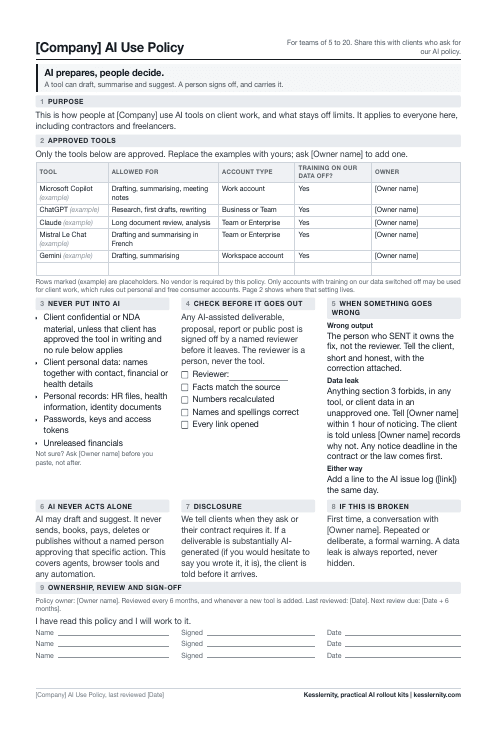
Most teams of five to twenty have no AI policy, and the ones that do have fourteen pages nobody opened. This is one page. Everyone reads it, everyone signs it, and it is reviewed every six months.
It is vendor-neutral. The tools table is a set of examples you replace with whatever your team already uses, and the test that matters is the setting rather than the brand: an account is approved for client work only if training on your data is switched off. That is a condition, not a clearance; the tool still has to be in your table, and what never goes into AI never goes in. Page 2 shows where the setting lives on five of them.
Page 1 stands alone, so you can print it, fill in the brackets and sign it without the other two. Its subtitle says what it is for: share this with clients who ask for our AI policy.
The line it is built on is at the top of every copy. AI prepares, people decide. A tool can draft, summarise and suggest. A person signs off, and carries it.
Where to next, for you
Three picks that follow from this page.
Free next step
Copilot, on one page
The loop to run when the answer matters, eight readiness boxes, and what to do about your score. Three pages, free.
Follows on from this page.
GoPaid option · $39
The Honest M365 Copilot Kit
Get genuinely good at Copilot, fast, and know when not to trust it.
15% off withHONESTQ4
Follows on from this page.
GoWorth a read
How to build your first prompt library
And why most teams should just take the free one.
Follows on from this page.
GoPicked from the pages you open here; that record stays in your browser and is never sent to us. .